Showing posts with label Education. Show all posts
Showing posts with label Education. Show all posts
Saturday, December 5, 2009
Quick Hit
WaPo reports: Teaching Mildly Autistic Kids the ABCs of Crucial Social Skills. I have mixed feelings about teaching social skills, but I'll reserve judgment on this one.

Tuesday, November 17, 2009
Life is a Highway: Part I
This is the second installment in a series of posts on interventions. Last week, I explored a speech therapy exercise that Brad has tried. This week, I muse about something we haven't tried. This installment is divided into two parts.
"[I]t is remarkable that an intervention that is easily defined and implemented can have important lasting benefits at least to the end of middle school for all students."
To what is the quote referring? Floortime? Occupational therapy? Behaviorial therapy? Diet? A supplement?
Answer: None of the above.
The excerpt is referring to an intervention that is elegant in its simplicity: classroom size. Science Daily reports:
Which is also interesting because my school district is amidst a budget crisis and a school crowding problem. The town I live in is having an override vote in December to fund some needed school repairs. If it doesn't pass, the children from the sick building may be forced to fan out into the already crowded grammar schools.
While I can't control how my town spends its money, I can control how I spend mine. Which is to say, I can send Brad to private school, if he can get over the admissions hump and can function without an aid.
I may look back at this very idea as crazy talk, but for now, it's something I'm at the very least considering down the road. Not for preschool, but for K-5 or K-8, when classroom size makes a preciptious jump in the public school setting. Private school offers small classroom size and appreciation of individual learning styles, and some "typical" private schools offer special ed-type services, including services for language and social pragmatics.
That having been said, my husband and I are both public school graduates and believers in the public school system. For most.
* * *
"[I]t is remarkable that an intervention that is easily defined and implemented can have important lasting benefits at least to the end of middle school for all students."
To what is the quote referring? Floortime? Occupational therapy? Behaviorial therapy? Diet? A supplement?
Answer: None of the above.
The excerpt is referring to an intervention that is elegant in its simplicity: classroom size. Science Daily reports:
Small classes in early grades improve test scores in later grades for students of all achievement levels, but low achievers get an extra boost. That's the finding of a study on the long-term effects of class size in the November issue of the American Journal of Education.The study followed 11,000 students and found that:
...small classes—13 to 17 students—are most effective when they are consistent from kindergarten through third grade. Students in consistently small early classes had substantially higher test scores in grades four through eight than students who had been in larger classes. Students at all achievement levels benefited, but low achievers showed stronger benefits in reading and science.Which is interesting because at least one noted blogger has hypothesized that "sensory processing disorders are probably among the most common reasons children underachieve in school."
Which is also interesting because my school district is amidst a budget crisis and a school crowding problem. The town I live in is having an override vote in December to fund some needed school repairs. If it doesn't pass, the children from the sick building may be forced to fan out into the already crowded grammar schools.
While I can't control how my town spends its money, I can control how I spend mine. Which is to say, I can send Brad to private school, if he can get over the admissions hump and can function without an aid.
I may look back at this very idea as crazy talk, but for now, it's something I'm at the very least considering down the road. Not for preschool, but for K-5 or K-8, when classroom size makes a preciptious jump in the public school setting. Private school offers small classroom size and appreciation of individual learning styles, and some "typical" private schools offer special ed-type services, including services for language and social pragmatics.
That having been said, my husband and I are both public school graduates and believers in the public school system. For most.
Monday, November 16, 2009
Life is a Highway: Part II
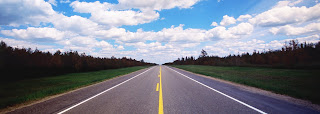
Education is a series of roadways. A metaphor. Indulge me.
Public school is a freeway, heavily trafficked and, at times, congested. There are several lanes, each with posted speeds. Drive too fast or too slow, and you're violating the law, which is strictly enforced by the police. The good news is that if you run out of gas or need help, highway patrol is there to assist. And if you need to drive in the slow lane, that option is available too. If you are at least a moderately fast car, the freeway is the best way to get to your destination.
Private school is a quiet country road. You can drive at your own pace; there is no minimum speed. You can drive fast on some stretches of the road, and slow on others. And when you drive slow on the country road, they don't call it "the slow lane." The problem is, if you need help or break down, you're on your own. There's no highway patrol, no one to assist. And on certain country roads, they won't even let you on the on-ramp unless your driving proficiency is at a minimum.
Homeschool is a parking lot. You can learn to drive expertly there, with zero risk of danger and no pressure to drive fast or slow. But you don't get to take in much by way of scenery, and you don't learn how to navigate when there are other cars on the road.
Public school is a freeway, heavily trafficked and, at times, congested. There are several lanes, each with posted speeds. Drive too fast or too slow, and you're violating the law, which is strictly enforced by the police. The good news is that if you run out of gas or need help, highway patrol is there to assist. And if you need to drive in the slow lane, that option is available too. If you are at least a moderately fast car, the freeway is the best way to get to your destination.
Private school is a quiet country road. You can drive at your own pace; there is no minimum speed. You can drive fast on some stretches of the road, and slow on others. And when you drive slow on the country road, they don't call it "the slow lane." The problem is, if you need help or break down, you're on your own. There's no highway patrol, no one to assist. And on certain country roads, they won't even let you on the on-ramp unless your driving proficiency is at a minimum.
Homeschool is a parking lot. You can learn to drive expertly there, with zero risk of danger and no pressure to drive fast or slow. But you don't get to take in much by way of scenery, and you don't learn how to navigate when there are other cars on the road.
Subscribe to:
Posts (Atom)